01
Base Wine Selection
The process starts with the right foundation. Weak input almost always leads to a weak result after dealcoholization.
- varietal fit
- aromatic potential
- structure and acidity

From technology to testing — everything in one place.
Why More Wineries Are Entering the Non-Alcoholic Category
Why More Wineries Are Entering the Non-Alcoholic Category
The rise of non-alcoholic wine is not a short-term trend. It reflects a broader shift in how consumers drink, choose, and define quality.
Moderation, health awareness, and new drinking occasions are opening space for a category that did not exist in the same way a few years ago.
For wineries, this creates a real opportunity to expand the portfolio, reach new customer segments, and stay relevant in a changing market.
But this is where many assumptions go wrong.
A successful non-alcoholic wine is not created by simply removing alcohol from an existing product. It requires a structured development process — from choosing the right base wine to testing, rebalancing, positioning, and final market fit.
That is the difference between a product that merely exists and one that is ready to sell.
Building a non-alcoholic wine is not a single step.
It is a structured process where each phase directly affects the final product — from the choice of base wine to testing, positioning, and market entry.
Understanding this sequence is critical.
Because skipping or compressing steps almost always leads to an average result.
Below is a simplified overview of how successful non-alcoholic wine products are developed in practice.
The process starts with the right foundation. Weak input almost always leads to a weak result after dealcoholization.
This is a critical production phase, but still only one part of the broader development system.
Once alcohol is reduced, the wine usually needs structural work to restore balance, mouthfeel, and harmony.
This is where assumptions are tested against reality through lab work, tasting, and repeated iteration.
The product must be defined as a credible offer with a clear place in the market, not just as a technical variant.
Even a strong product needs the right route to market. Commercial fit determines whether it will actually sell.
Each phase shapes the next one. That is why successful non-alcoholic wine development is not based on a machine alone, but on a connected process from first testing to market-ready execution.
The quality of the final product is determined long before dealcoholization begins. It starts with the base wine.
When alcohol is removed, the structure of the wine changes significantly. Body, balance, and aromatic integration are all affected. Wines that feel acceptable in their original state can quickly become thin, sharp, or disconnected after alcohol reduction.
This is why the selection of the base wine is not a secondary decision. It is one of the most critical factors in the entire process.
Not every wine is suitable for dealcoholization. Choosing the right starting point is what separates a viable product from one that will struggle in the next stages of development.
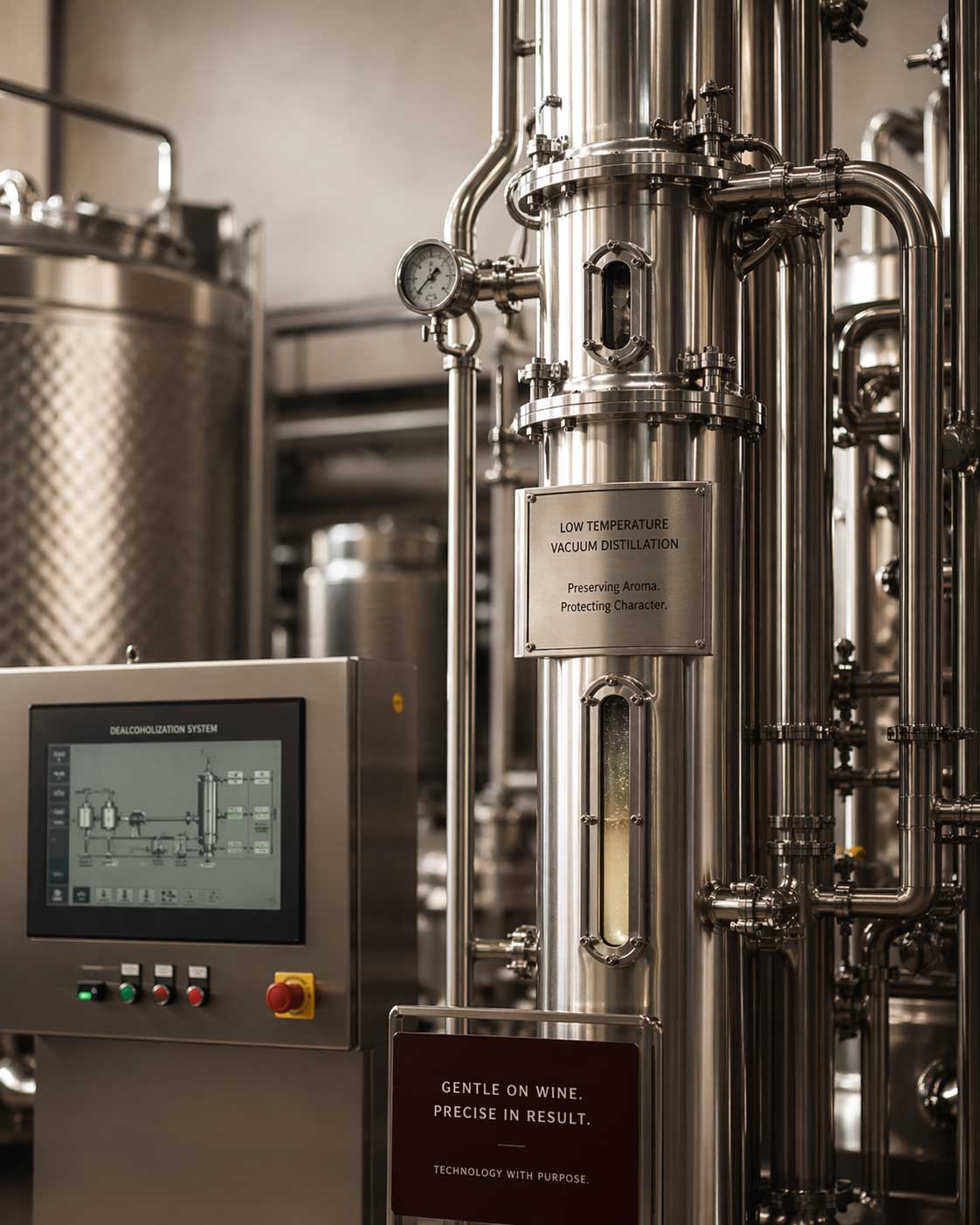
Modern alcohol removal systems can preserve a significant share of the wine’s aromatic profile — especially when they operate under controlled, low-temperature conditions.
At this stage, ethanol is removed in a controlled way, but the output is still not market-ready. Parameters must be adjusted according to the specific wine, the desired alcohol level, and the intended product profile.
The goal is not simply to remove alcohol. The goal is to reduce it while preserving as much aroma, structure, and varietal character as possible.
This is why the process must be approached as a system rather than a single technical operation. What happens here directly affects everything that follows — especially rebalancing, testing, and final sensory quality.
After alcohol removal, the wine rarely feels complete. Structure changes, balance shifts, and the original harmony is often lost.
Removing alcohol affects body, mouthfeel, and the way aromas integrate. What remains is often technically correct, but sensorially incomplete. This is why rebalancing is not optional — it is a defining phase of the process.
At this stage, the goal is to rebuild a coherent product. That can include blending, adjusting structure, and redefining the intended style of the final wine.
This is the step where a technical output becomes a product people can actually enjoy — and where most of the differentiation between average and high-quality non-alcoholic wine is created.
At this stage, intuition is not enough. Without structured testing, development becomes guesswork — and that is one of the main reasons why many non-alcoholic wines fail.
Every adjustment made in previous steps must now be validated. This includes both technical parameters and sensory perception. What looks correct on paper does not always translate into a balanced product.
Development follows an iterative process — test, adjust, and test again. Each change affects multiple aspects of the wine, which is why refinement cannot be done in one pass.
One of the most common misconceptions is that this phase can be completed quickly. In reality, developing a stable, market-ready product often takes several months — in many cases up to three to six months, depending on the desired style and level of precision.
This is not inefficiency. It is the difference between a technically processed liquid and a product that can actually succeed in the market.
The wineries that succeed in this category are not the ones that move fastest, but the ones that are willing to iterate until the product is right.
Even a well-developed non-alcoholic wine can fail if it is positioned incorrectly. This is one of the most underestimated factors in the entire process.
Consumers naturally compare it to traditional wine. And in that comparison, non-alcoholic wine rarely wins — not because it lacks quality, but because the expectations are wrong.
Successful products take a different approach. They define a new category experience, rather than trying to imitate an existing one.
This affects everything — from packaging and naming to pricing and distribution strategy. The product is no longer evaluated as “wine without alcohol,” but as a distinct offering with its own purpose.
The difference between products that struggle and those that succeed is often not technical — it is how clearly they are positioned in the mind of the consumer.
By this stage, the product may be technically ready. But without a clear route to market, even well-developed non-alcoholic wines struggle to gain traction.
Market success depends on how the product is introduced, where it is positioned, and how it reaches the consumer. This is not a single decision, but a combination of choices that define commercial viability.
Many products fail not because they are poorly made, but because they are introduced without a clear strategy. The market does not reward effort — it responds to clarity and relevance.
This is why development and go-to-market should never be separated. The product should be designed with its final market in mind from the very beginning.
At this point, the process comes full circle. What started as a technical idea becomes a real product only when it reaches the right consumer, in the right context, with the right positioning.
Building a non-alcoholic wine is not a single step.
It is a structured process where each phase directly affects the final product — from the choice of base wine to testing, positioning, and market entry.
Understanding this sequence is critical.
Because skipping or compressing steps almost always leads to an average result.
Below is a simplified overview of how successful non-alcoholic wine products are developed in practice.
Building a non-alcoholic wine brand is not a technical adjustment.
It is a structured development process that combines production, testing, sensory refinement, and strategic decision-making.
The wineries that succeed are not the ones that move fastest, but the ones that approach it as product development — not as a quick modification.
Developing a non-alcoholic wine requires more than individual capabilities.
It requires a coordinated system of technology, testing, expertise, and iteration — all working together from the beginning.
This allows projects to move from concept to market-ready product with clarity, speed, and control.
From technology and testing to product refinement and market readiness, every stage works better when the process is developed as one connected system.
We use cookies to improve your experience and understand how our technology is used.
You can accept all cookies or choose what to allow.
Let’s talk about your case
Choose the option that best matches where you are.