Wine Dealcoholization Explained

How Wine Dealcoholization Works

Understand how alcohol is gently removed from wine while preserving its structure, aroma, and balance.

Separation column Evaporation vessel Vacuum Heating Circulation Condenser

How Alcohol Is Removed
from Wine

Alcohol is not simply “taken out” of wine. It is selectively separated through controlled temperature and pressure conditions that allow ethanol to evaporate while preserving the rest of the wine’s structure.

The process is based on low-temperature vacuum evaporation, followed by precise separation and condensation.

Step by step:

— Wine is gently heated and placed under vacuum

— Alcohol evaporates at low temperature

— Wine structure and aromas are preserved

Scroll to see the process step by step

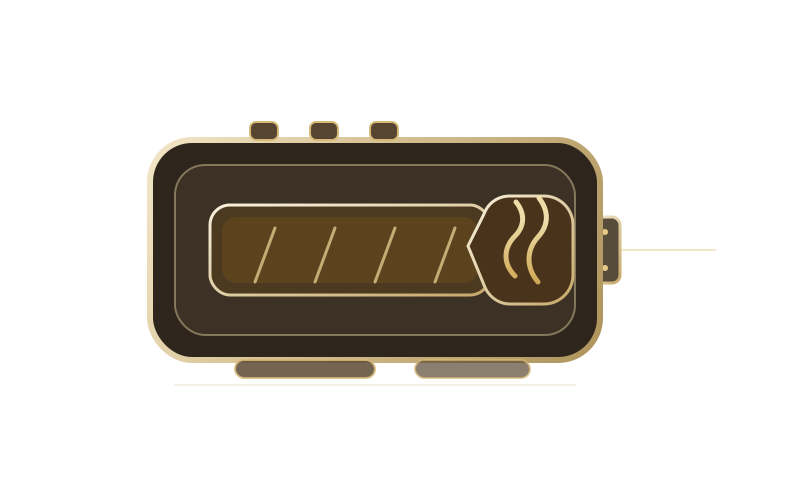
Wine dealcoholization evaporation vessel
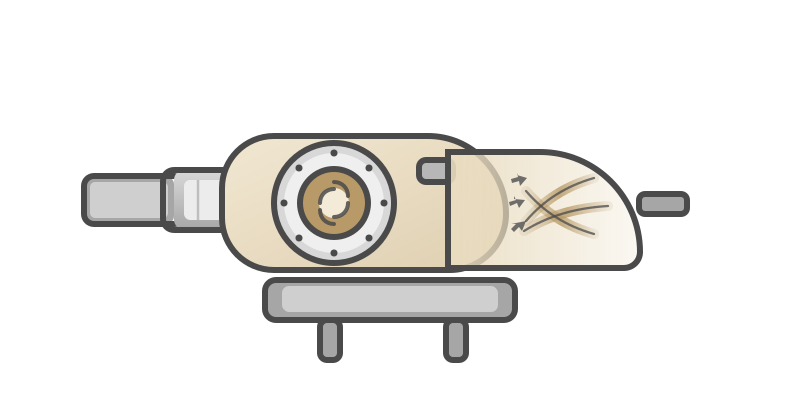
Separation column for wine dealcoholization process
Vacuum pump for low pressure wine evaporation
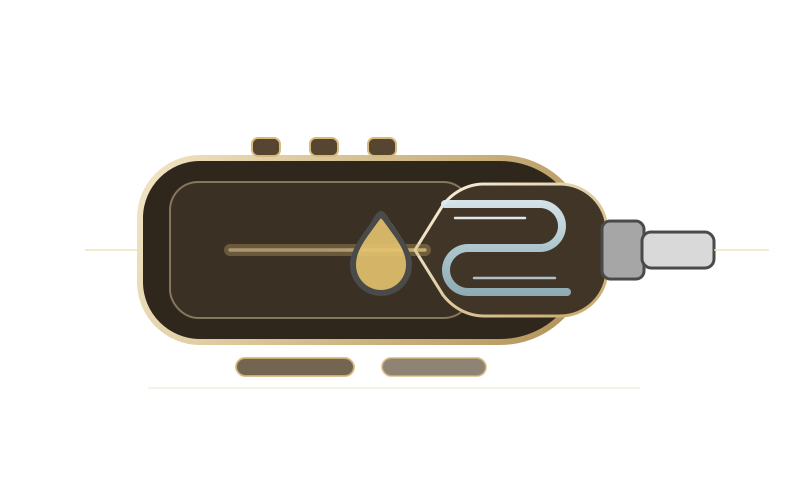
Heating system for controlled wine temperature
Mixing pump for uniform wine circulation
Condenser for ethanol vapor recovery
Ethanol outlet from dealcoholization system
Evaporation vessel
Separation column
Vacuum system
Heating system
Circulation pump
Ethanol condenser
Ethanol outlet

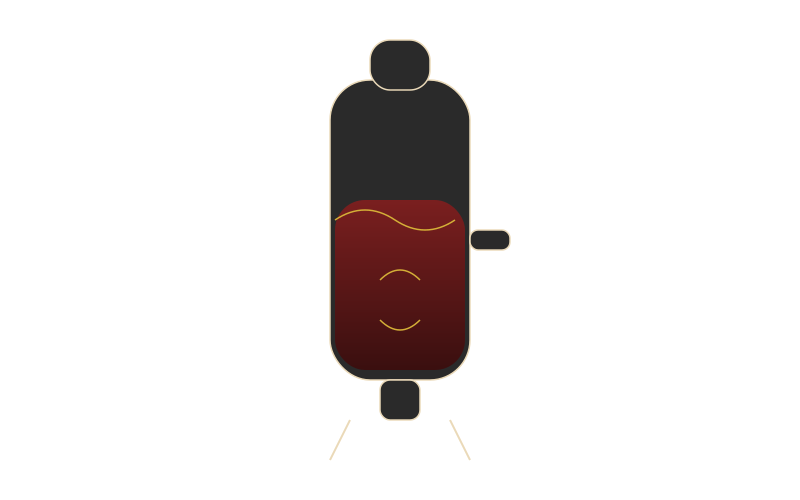
Wine enters the vessel

Wine is introduced into the evaporation vessel, where it remains throughout the entire process.

Heating and mixing prepare the process

The wine is gently heated and circulated to maintain controlled process conditions before evaporation begins.

Vacuum initiates low-temperature evaporation

Reduced pressure allows ethanol to evaporate at low temperature, helping preserve the wine structure.

Separation occurs in the column

Inside the separation column, wine components condense and return to the vessel, while ethanol continues forward in vapor form.

Ethanol is condensed and collected

The ethanol vapor is cooled, condensed, and directed to the ethanol outlet, while dealcoholized wine remains in the vessel.

Step 1

Wine enters the vessel

Wine dealcoholization evaporation vessel

Evaporation vessel

Wine is introduced into the evaporation vessel, where it remains throughout the entire process.

Step 2

Heating and mixing prepare the process

Heating system for controlled wine temperature

Heating system

Mixing pump for uniform wine circulation

Circulation pump

The wine is gently heated and circulated to maintain controlled process conditions before evaporation begins.

Step 3

Vacuum initiates low-temperature evaporation

Vacuum pump for low pressure wine evaporation

Vacuum system

Reduced pressure allows ethanol to evaporate at low temperature, helping preserve the wine structure.

Step 4

Separation occurs in the column

Separation column for wine dealcoholization process

Separation column

Inside the separation column, wine components condense and return to the vessel, while ethanol continues forward in vapor form.

Step 5

Ethanol is condensed and collected

Condenser for ethanol vapor recovery

Ethanol condenser

Ethanol outlet from dealcoholization system

Ethanol outlet

The ethanol vapor is cooled, condensed, and directed to the ethanol outlet, while dealcoholized wine remains in the vessel.
How Wine Dealcoholization Works

Wine dealcoholization using low-temperature vacuum technology is a controlled process that removes ethanol while preserving the structure, aroma, and character of the wine.

The process operates in cycles of gentle heating and vacuum conditions, allowing ethanol to evaporate at significantly lower temperatures than in conventional systems. This ensures minimal impact on delicate wine compounds while enabling efficient alcohol removal.

Ethanol is then separated and recovered as a high-purity liquid, while the dealcoholized wine remains stable within the system.

Understanding how the process works is only one part of the equation. To see how this translates into a real business case, explore whether non-alcoholic wine is actually profitable .

See how this process performs with your wine.

Process breakdown

Low-Temperature Evaporation

The process begins in the evaporation vessel, where the wine is maintained within a controlled temperature range of approximately 18–23°C.

  • Operates at low temperatures (18–23°C)
  • Uses vacuum to reduce the boiling point of ethanol
  • Prevents thermal damage and preserves wine integrity

Unlike traditional distillation, this approach avoids high temperatures that can strip aroma and structure from the wine.

Understand if your wine is suitable first

Controlled Separation in the Column

Once ethanol begins to evaporate, vapor flows into a temperature-controlled separation column.


  • Separation occurs inside a cooled column
  • Wine components condense and return to the vessel
  • Ethanol remains in vapor phase and continues forward

This selective behavior between wine compounds and ethanol is the key to maintaining product quality.

Ethanol Condensation and Recovery

Ethanol vapor is directed into a condenser, where it is cooled to approximately –5°C and transformed back into liquid form.


  • Ethanol is condensed at low temperature
  • Recovered as a liquid with high purity
  • Up to 95.6% ethanol concentration

This enables not only alcohol removal, but also the recovery of a valuable by-product.

Continuous Cycle Operation

Low-temperature vacuum dealcoholization offers a balanced combination of quality preservation and process efficiency.


  • Preserves aroma and varietal character
  • Avoids aggressive processing conditions
  • Maintains structural integrity of the wine
  • Enables consistent and repeatable results

While no dealcoholization method can produce a 100% identical result to the original wine, this approach minimizes sensory deviation and is widely suitable for premium wine production.

Comparison with Other Dealcoholization Technologies

Reverse Osmosis (RO)

  • Membrane-based separation process
  • Partial loss of aroma compounds


Spinning Cone Column (SCC)

  • High-end technology with strong aroma preservation
  • Complex system with high investment and operating costs


Low-Temperature Vacuum System (Dioniks)

  • Excellent balance between quality and cost
  • Minimal aroma loss and structural impact
  • Lower system complexity and maintenance
  • Enables high-purity ethanol recovery


This makes low-temperature vacuum technology a highly efficient and scalable solution for wineries targeting premium non-alcoholic or low-alcohol products.

Evaluate whether this is the right solution for your winery.

Frequently asked questions

What production capacity can be achieved? +

Production depends on system size. A 500 L batch system can process approximately one batch every 48 hours, resulting in around 50,000 liters per year. Request an evaluation for your expected volume →

Does the wine lose its aroma?+

Complete preservation is not possible, but the majority of varietal and fruit characteristics remain intact. The final product is typically adjusted as a cuvée. See how your specific wine profile behaves →

What happens to the removed alcohol? +

Ethanol can be recovered at high purity (up to 95.6%) and reused or sold for other applications. Explore recovery options for your production →

What temperature does the process operate at?+

The core process operates between 18°C and 23°C, avoiding thermal stress on the wine. Get a breakdown for your setup →

How much product is lost? +

Typical losses are between 1–2%, with the possibility of further reduction through optimization. Estimate losses for your production →

How complex is operation? +

The system requires minimal operator involvement, mainly at the start and end of each cycle. See how this fits into your workflow →

Still have questions or want a direct assessment?

Start Your Non-Alcoholic Wine Project

Tell us where you are — we’ll define the right path for your winery.

We’ll review your case and suggest the best next step.

Plan Your Production Setup

Define the right production model, capacity, and operational fit for your winery.

We’ll review your case and suggest the best next step.

Discuss Strategic Partnership

Tell us about your product, production goals, or expansion plans — we’ll define the right collaboration model.

We’ll review your case and suggest the best next step.

Let’s talk about your case

How Would You Like to Start?

Choose the option that best matches where you are.