
Non-alcoholic wine succeeds or fails long before bottling. The most important decisions happen during product development: which base wine to use, how it behaves during dealcoholization, how structure changes, and what adjustments are needed to rebuild balance.
Alcohol carries aroma, contributes to body, and affects mouthfeel. Once it is removed, the wine changes. Some wines remain convincing. Others become thin, aromatically weak, or unbalanced.
This is why serious development starts with evaluation and testing, not assumptions. Before moving into production, wineries need to understand whether their wine can realistically become a strong non-alcoholic product.
If you are still evaluating your base wine, start with this guide: is your wine suitable for dealcoholization?
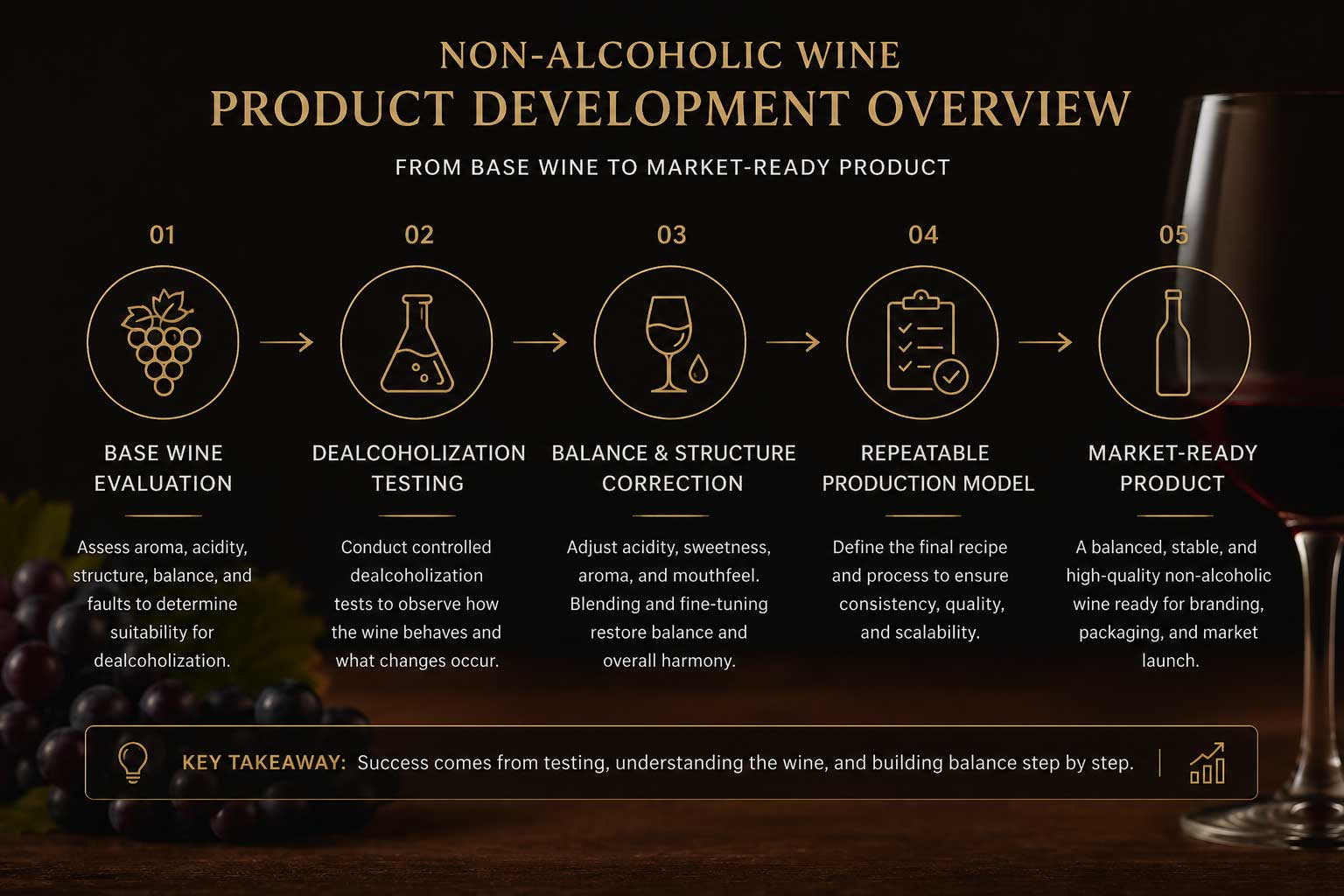
A successful non-alcoholic wine is developed through a sequence of controlled decisions, not a single technical step.
The starting wine is assessed for aroma, acidity, structure, balance, and faults. Weaknesses at this stage usually become more visible after alcohol removal.
Controlled testing shows how the wine actually behaves when alcohol is reduced or removed. This is where assumptions are replaced by evidence.
The first result is rarely final. Blending, sweetness, acidity, mouthfeel, and aromatic balance may need to be adjusted.
Once the product works, the goal is to create a repeatable recipe and production model that can be scaled reliably.
For the technical foundation behind the alcohol removal step, see how wine dealcoholization works.
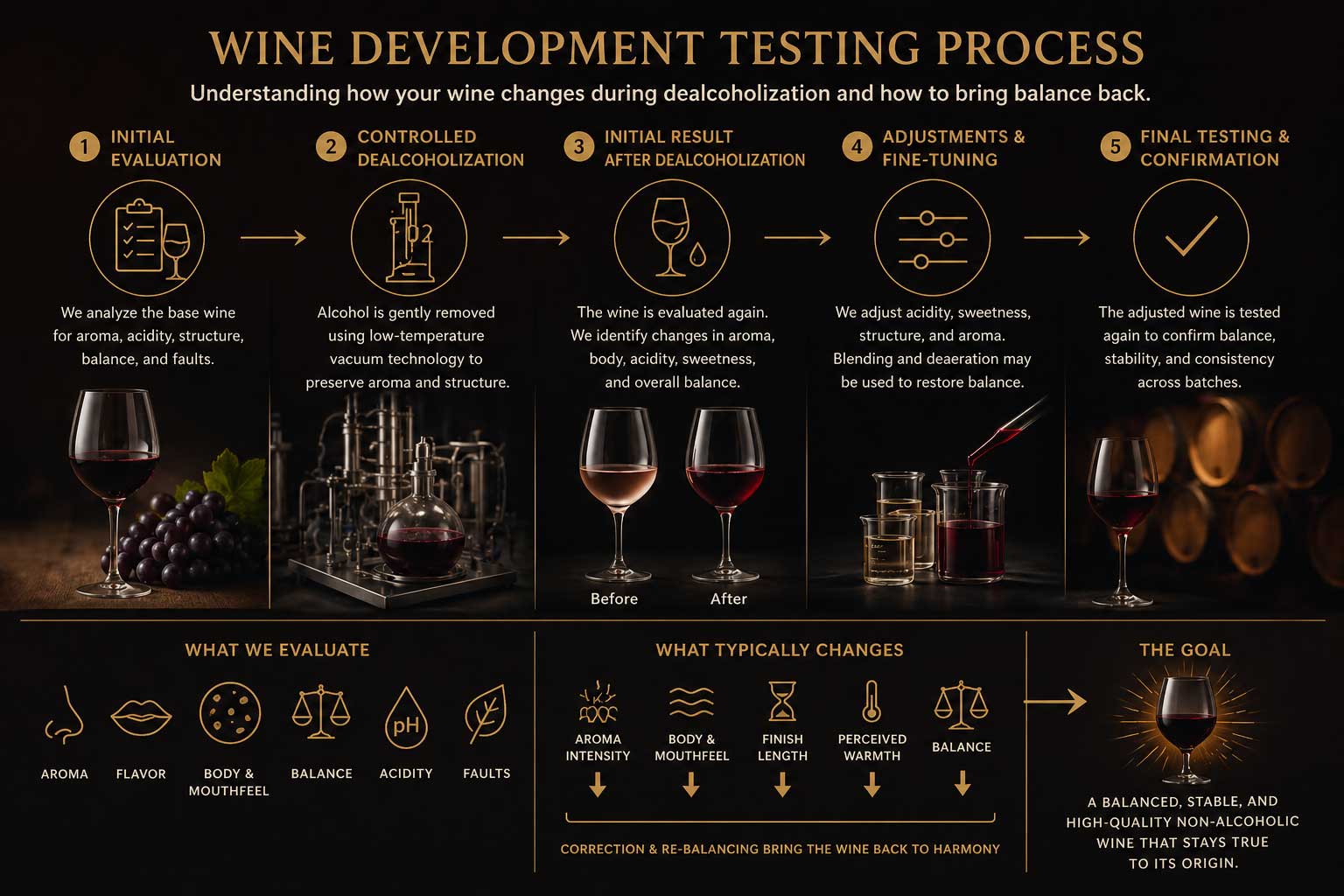
Testing is not there to confirm that an idea is good. It is there to show what the wine actually becomes after dealcoholization.
This matters because alcohol removal changes aroma expression, body, finish, and balance. Even a strong base wine may need adjustment before it becomes a commercially convincing non-alcoholic product. Many projects fail because wineries underestimate these development challenges during early testing.
The real objective is not just to remove alcohol. The objective is to create a final product that still has structure, identity, and repeatability.
If cost is part of the decision, compare the development path with the cost of wine dealcoholization per liter.
The strongest non-alcoholic wine projects begin with structured evaluation and controlled testing. That is the only reliable way to understand whether a wine can become a balanced, repeatable product.